Document · CMS calculator
Swifts cable ladder catalogue 2025 — Table 6
publishedcms.doc.swiftsTable6
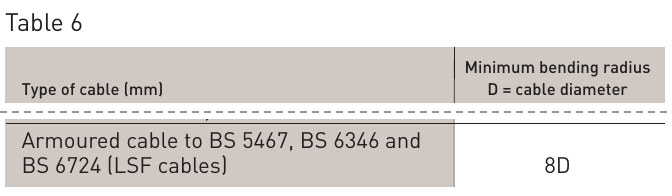
The ladder maker's own table of minimum bending radii, as a multiple of the cable's diameter, by type of cable. Armoured cable to the British cable standards is given the largest multiple.
Local graph
publishedestimateda choiceno sourceArrows: the way the data flows
The original document
- Publisher
- Legrand
- Title
- Swifts® cable ladder (UK edition)
- Edition
- 2025
- Where in it
- p.127 — Table 6, minimum bending radius of cables
- Do we hold it
- Sparkline’s PDF
- May it be reproduced here
- In small extracts, quoted with acknowledgement. The document is the authority.
Legrand UK — Swifts cable ladder ↗ We are not the source of record.
What the document says
How the calculator uses it
It is one of the two documents behind the bending radius basis: for armoured cable it agrees with the cable maker's own figure, which is why the calculator bends at eight times the diameter by default.
Watch for
The middle unarmoured row prints its diameter bounds the wrong way round ("25 mm < D < 10 mm"); the extract shows it as printed. No figure from the table is read by the code — it is one of the documents behind the default.