When Do You Need a Protection Study?

A protection study shows that every fault is cleared by the nearest device, fast enough to keep people safe and cables within their limits, without tripping more of the installation than it must. You need one for a new installation or an extension, after a change of supply, transformer or generator, when solar, batteries or EV charging are added, and when a nuisance trip or a fault has shown that the settings are wrong.

LV Discrimination

We model the network in Trimble ProDesign with manufacturer data for every breaker and fuse, and check discrimination two ways: time–current curves for overload and short circuit, and the manufacturers' published discrimination tables for the energy-based check. Where full discrimination is not possible, we show the fault current up to which it holds and the device or setting changes that improve it.

HV Relay Coordination and Settings

For HV networks we model the system in ETAP or PowerFactory, calculate maximum and minimum fault levels to BS EN 60909, and grade the overcurrent and earth fault relays, the transformer protection and the interface with the DNO. You receive a settings schedule ready for the commissioning engineer.

For solar, batteries and other generation we set and document the interface protection that EREC G99 requires — over and under voltage, over and under frequency, and loss of mains — and coordinate it with the site's own protection.

Arc Flash Studies

We calculate the incident energy at each switchboard and panel within the scope of IEEE 1584 — three-phase AC systems from 208 V to 15 kV — at the working distance for that equipment, set the arc flash boundaries and produce the equipment labels. Equipment outside that scope, such as DC systems, is listed in the report. Where the energy is high, we show what brings it down: faster protection settings, a maintenance setting or a change of device.

Time-current plot on log scales. The downstream gG fuse curve falls steeply on the left. The upstream protection relay curve has a pick-up current, an inverse-time (IDMT) stage and a definite-time high-set stage, and stays above and to the right of the fuse at every current. At the fault current marked by a dashed line, the fuse clears first and the relay would wait for the grading margin.Time-current plot on log scales. The downstream gG fuse curve falls steeply on the left. The upstream protection relay curve has a pick-up current, an inverse-time (IDMT) stage and a definite-time high-set stage, and stays above and to the right of the fuse at every current. At the fault current marked by a dashed line, the fuse clears first and the relay would wait for the grading margin.
Illustrative curves: a gG fuse and the protection relay upstream of it, with an inverse-time stage and a high-set stage. At every current the relay waits longer than the fuse by more than the grading margin, so the fuse clears the fault first. Open full size
An arc flash label layout with fields for incident energy, working distance, arc flash boundary, nominal voltage, and equipment and study reference.An arc flash label layout with fields for incident energy, working distance, arc flash boundary, nominal voltage, and equipment and study reference.
What each label carries. The values come from the study for that piece of equipment. Open full size
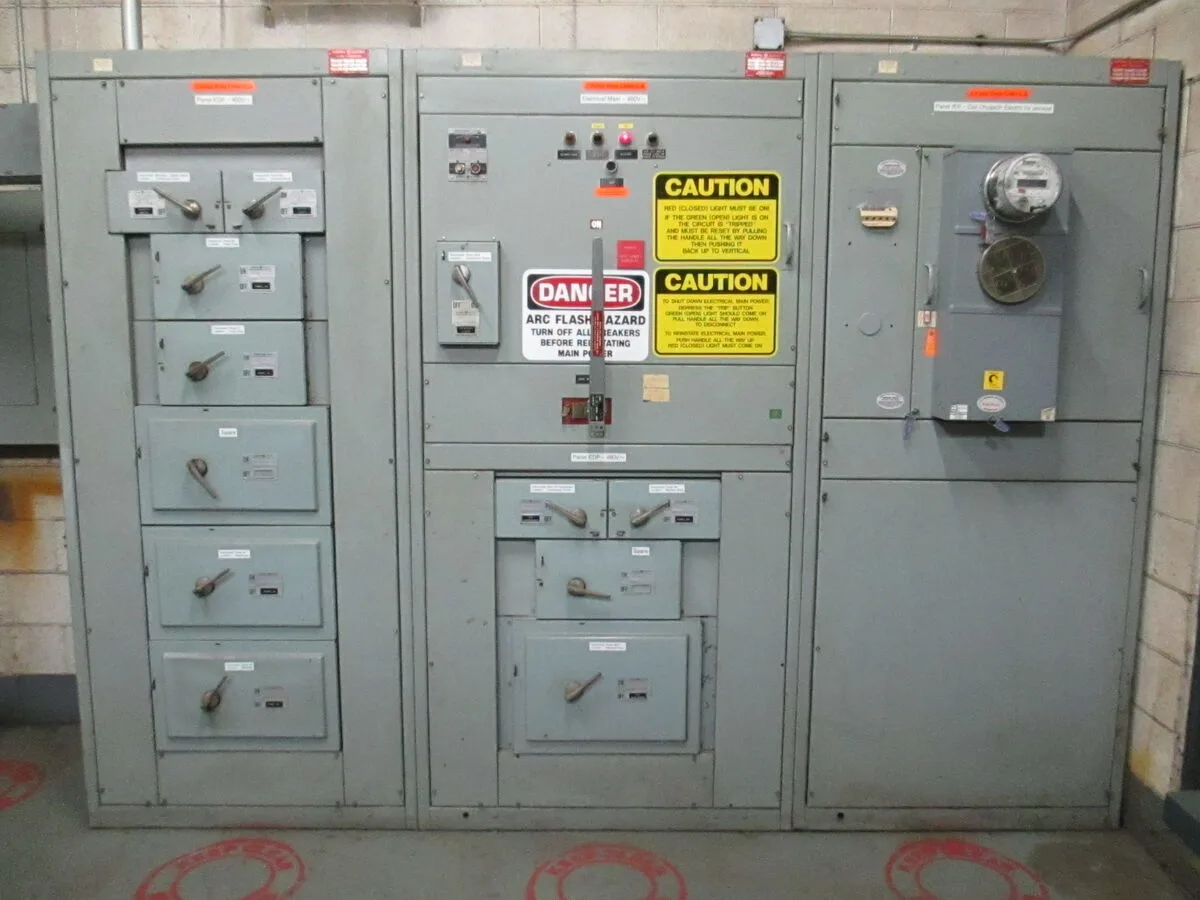
A 480 V main distribution panel with arc flash warning labels on its doors.
Arc flash warning labels on a main distribution panel. Photo: Zaereth, CC BY-SA 4.0, resized

What You Receive

  • A study report with the network model, data sources and assumptions
  • Maximum and minimum fault levels at every board
  • Time–current curves for each protection path
  • Discrimination results, with the changes recommended
  • A relay and breaker settings schedule
  • Arc flash results and equipment labels, when arc flash is in scope
  • The native ProDesign, ETAP or PowerFactory model on request

What We Need From You

  • The single-line diagram
  • Protective devices: make, type, rating and current settings
  • Cable types, sizes and lengths
  • Transformer and generator data
  • The DNO fault level and earthing arrangement
  • For arc flash: switchgear types and working distances

Relevant Standards

  • BS 7671:2018+A4:2026
  • BS EN 60909-0
  • BS EN 60947-2
  • BS EN 60255
  • ENA EREC G99
  • IEEE 1584-2018
  • Electricity at Work Regulations 1989
  • Management of Health and Safety at Work Regulations 1999

Read our guide to discrimination and selectivity. Cable sizing and fault levels for the same network come from our ProDesign cable calculation service.

Frequently Asked Questions

Common questions about protection studies and arc flash.

Is discrimination the same as selectivity?

Yes. UK designers usually say discrimination; IEC standards and manufacturers say selectivity. Both mean that the device nearest the fault opens and the device upstream stays closed.

Is an arc flash study a legal requirement in the UK?

No UK regulation names it. The Management of Health and Safety at Work Regulations 1999 (Regulation 3) require a suitable and sufficient risk assessment, and the Electricity at Work Regulations 1989 (Regulation 4) require electrical systems to be built and maintained to prevent danger so far as is reasonably practicable. An arc flash study puts numbers on the arc flash hazard for both.

Which software do you use?

ProDesign for LV networks to BS 7671, and ETAP or PowerFactory for HV networks, relay coordination and arc flash. If your client names the software, we use it, and we can hand over the native model.

Can you set the protection for a solar or battery connection?

Yes. We set and document the interface protection under EREC G99 and coordinate it with the site's own protection, ready for the DNO application and commissioning.

Can you check an existing installation?

Yes. We build the model from the single-line diagram and the device data on site, and report where discrimination or fault clearance fails, with the changes that fix it.

What does an arc flash label show?

The incident energy at a stated working distance and the arc flash boundary for that piece of equipment. It informs the risk assessment and the choice of protective clothing, alongside safe isolation and the site's other safe systems of work.

Need a Protection Study?

Send the single-line diagram and device data — we'll confirm the scope, the inputs we need, and the cost.

Get a Quote